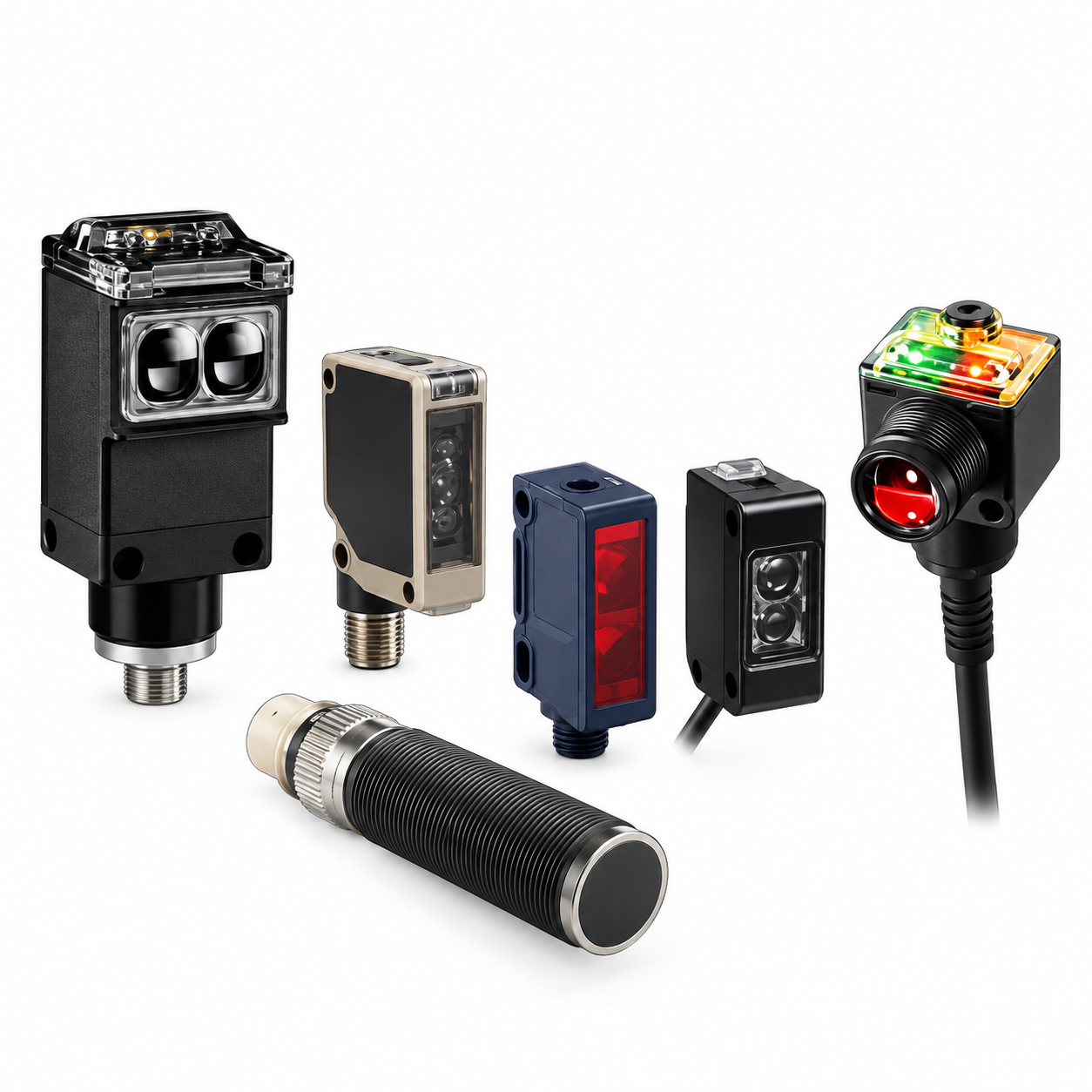
Sensor Manufacturers in Mumbai | Aerocircle Automation
Aerocircle Automation is leading Sensor Manufacturers, Dealers, Suppliers, Distributors and Traders in Mumbai. A sensor is an electronic or electromechanical device that detects physical conditions and converts them into signals that can be processed by a control or automation system. Sensors are essential for monitoring, measurement, detection, and decision-making in modern industrial processes.
Industrial sensors are widely used in manufacturing, packaging, automotive, robotics, material handling, process industries, and machine automation. They help machines detect objects, measure process parameters, monitor movement, and maintain controlled operation.
What is an Industrial Sensor?
An industrial sensor detects changes in physical conditions such as distance, temperature, pressure, flow, level, position, motion, light, or the presence of an object. The sensor sends a corresponding signal to a PLC, controller, HMI, or other automation equipment.
An automation sensor can therefore act as an important interface between the physical machine and its control system. Multiple sensors can be combined to create integrated sensor systems for monitoring and controlling industrial processes.
Sensor Service Providers in Mumbai
Sensor Service Providers in Mumbai offer reliable solutions for the installation, calibration, repair, maintenance, and troubleshooting of industrial sensors. These providers support proximity, photoelectric, pressure, temperature, level, and other automation sensors, helping industries improve accurate detection, process monitoring, machine performance, and overall operational efficiency.
Types of Sensors
As we are leading Sensor Manufacturers in Mumbai, our Types are designed to meet different application requirements and industry standards, including the following types:
Proximity Sensor: A proximity sensor detects the presence or absence of an object without requiring physical contact. It is commonly used for object detection, machine positioning, counting, and automation applications.
Inductive Sensor: An inductive sensor detects metallic objects using an electromagnetic sensing principle. It is widely used for detecting machine components, metal parts, position, and end-of-travel conditions.
Capacitive Sensor: A capacitive sensor detects changes in capacitance and can be used to detect both metallic and non-metallic materials. Typical applications include level detection, material presence, and product sensing.
Photoelectric Sensor: A photoelectric sensor uses light to detect objects. It is suitable for counting, presence detection, product positioning, conveyor applications, and packaging machinery.
Ultrasonic Sensor: An ultrasonic sensor uses sound waves to detect objects or measure distance. It can be useful for applications involving transparent, reflective, irregularly shaped, or certain non-metallic objects.
Magnetic Sensor: A magnetic sensor detects magnetic fields or the presence of magnetic targets. It is commonly used for position detection, cylinder sensing, and machine monitoring.
Temperature Sensor: A temperature sensor measures temperature within a machine or process. It can be used for equipment monitoring, process control, overheating detection, and environmental measurement.
Pressure Sensor: A pressure sensor measures pressure in pneumatic, hydraulic, or process systems. The measured value can be sent to a controller for monitoring or automated control.
Flow Sensor: A flow sensor detects or measures the movement of liquids or gases through a system. It is used in process monitoring, cooling systems, fluid handling, and industrial equipment.
Displacement Sensor: A displacement sensor measures the movement or change in position of an object. It is useful for precision measurement, dimensional monitoring, and machine positioning.
Motion Sensor: A motion sensor detects movement or changes in motion. Depending on the technology, it can be used for machine monitoring, object detection, and automation functions.
Safety Sensor: A safety sensor is used as part of a machine safety system to detect defined hazardous conditions, access, or presence. It can be integrated with safety controllers, safety relays, and other protective devices.
Sensor Controller and Monitoring System
A sensor controller receives signals from sensors and can process them according to the requirements of the automation application. Depending on the system, it may provide switching, measurement, communication, or control functions.
A sensor monitoring system combines sensors, controllers, communication equipment, and software to provide real-time information about machines or processes. It can support centralized monitoring and automated responses.
Sensor Integration with Industrial Automation
Sensors can be connected to PLCs, HMIs, robot controllers, motion-control systems, safety controllers, and other industrial automation equipment.
For example, a proximity sensor can detect a component on a conveyor and send a signal to the PLC. The PLC can then command a robot, actuator, or conveyor to perform the next programmed operation.
Key Features of Sensors
As Sensor Suppliers in Mumbai, our products provide several Features including consistent quality, smooth finish, and long service life.
Accurate Detection: Industrial sensors provide reliable detection of objects, positions, process conditions, or other physical parameters according to their technology and application.
Fast Response: Many automation sensors are designed to respond quickly to changing conditions, making them suitable for high-speed production processes.
Non-Contact Detection: Technologies such as photoelectric, ultrasonic, laser, and proximity sensing can detect objects without requiring direct physical contact.
Continuous Monitoring: Temperature, pressure, flow, level, and other measuring sensors can provide continuous process information for monitoring and control.
Flexible Integration: Sensors can be integrated into existing automation architectures through suitable electrical signals, communication interfaces, and controllers.
Industrial Durability: Industrial sensors are available in configurations designed for demanding environments involving factors such as dust, moisture, vibration, and temperature variations.
Applications of Sensors
As Sensor Dealers in Mumbai, our all types are used in various types of industrial sectors such as:
Manufacturing Automation: Sensors are used for object detection, positioning, counting, machine sequencing, and process monitoring across manufacturing operations.
Conveyor Systems: Proximity sensors, photoelectric sensors, and vision sensors can detect products and control movement along automated conveyor systems.
Robotics: Sensors provide robots with information about object presence, position, distance, and machine conditions, supporting automated handling and assembly.
Packaging Machines: Sensors can detect products, packaging materials, positions, and machine conditions during filling, sealing, labeling, sorting, and packaging operations.
Process Industries: Temperature, pressure, flow, and level sensors are widely used to monitor process parameters in fluid and material-handling systems.
Machine Safety: Safety sensors can be integrated into machine protection systems to detect defined access or hazardous conditions and initiate appropriate safety functions.
Benefits of Sensors
As Sensor Distributors in Mumbai, our products provide several benefits including consistent quality, smooth finish, and long service life.
Improved Process Control: Sensors provide real-time information that helps automated systems maintain controlled machine and process operation.
Increased Productivity: Automated detection and measurement can reduce manual intervention and support faster production cycles.
Better Accuracy: Sensors can provide consistent detection and measurement according to their specified performance characteristics.
Reduced Human Intervention: Automated sensing allows machines to detect conditions and respond through programmed control systems.
Improved Machine Monitoring: Sensors can monitor important operating conditions and provide information for process supervision and maintenance.
Flexible Applications: Different sensor technologies can be selected for object detection, measurement, positioning, process monitoring, and safety requirements.
How to Choose the Right Sensor
Choosing the right industrial sensor depends on the target material, sensing distance, required accuracy, response time, operating environment, mounting arrangement, output signal, and controller compatibility.
For example, an inductive sensor is generally suitable for detecting metal objects, while a photoelectric sensor can be used for non-contact object detection. Temperature, pressure, flow, and level applications require sensors specifically designed for their respective process parameters.
Why Choose Us for Industrial Sensor Solutions?
Proximity Sensors: Proximity sensors can be used for suitable object detection, position sensing, presence detection, and machine-control applications without requiring direct physical contact.
Photoelectric Sensors: Photoelectric sensors can support object detection, counting, positioning, and presence or absence detection in suitable industrial automation applications.
Ultrasonic Sensors: Ultrasonic sensors can be used for suitable distance, object detection, and level-measurement applications where non-contact sensing is required.
Temperature, Pressure, and Flow Sensors: We can support applications requiring temperature sensors, pressure sensors, and flow sensors for monitoring relevant process parameters in industrial systems.
Level Sensors: Level sensors can support suitable tank, container, and process applications requiring detection or monitoring of material levels.
Choose Aerocircle Automation is leading Sensor Manufacturers, Dealers, Suppliers, Distributors and Traders in Mumbai. A sensor is a fundamental component of industrial automation, providing machines and control systems with information about their physical environment and operating conditions. Technologies such as proximity sensors, photoelectric sensors, ultrasonic sensors, inductive sensors, capacitive sensors, temperature sensors, pressure sensors, flow sensors, level sensors, vision sensors, and safety sensors serve different industrial requirements.
Selecting the right industrial sensor according to the sensing target, range, accuracy, response time, environment, output, and controller compatibility can help improve automation performance. When properly integrated into a complete sensor system, industrial sensing technology supports reliable detection, measurement, monitoring, and automated machine control.
FAQ’s
An industrial sensor detects physical conditions such as object presence, position, temperature, pressure, flow, level, or motion and provides a signal to an automation or control system.
A proximity sensor is commonly used for non-contact detection of objects, machine-position monitoring, counting, and automated equipment control.
Inductive sensors are primarily used for detecting metallic objects, while capacitive sensors can detect a wider range of materials, including certain non-metallic materials.
A photoelectric sensor uses light to detect the presence, absence, or position of an object without requiring physical contact.
Yes. Compatible industrial sensors can be connected to PLCs through suitable digital, analog, or supported communication interfaces.
Hi there! 👋
Fill out the form below to start a conversation with us on WhatsApp.
Hi there! 👋
Fill out the form below to start a conversation with us on WhatsApp.