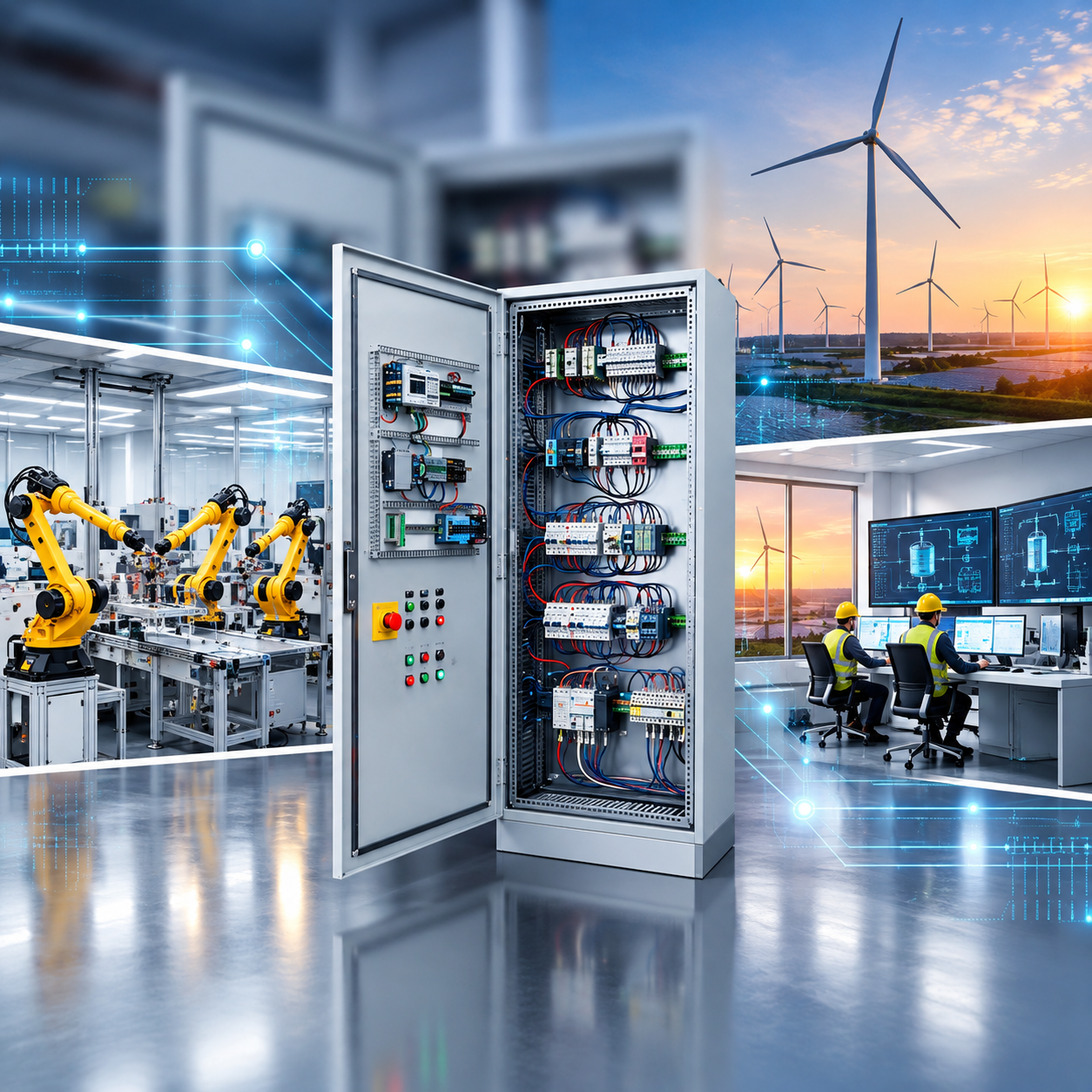
PLC Manufacturers in Mumbai | Aerocircle Automation
Aerocircle Automation is leading PLC Manufacturers, Dealers, Suppliers, Distributors and Traders in Mumbai. A PLC (Programmable Logic Controller) is an industrial control device used to automate machines, production processes, and manufacturing operations. It continuously receives input signals, processes programmed logic, and controls connected outputs.
PLC automation is widely used in factories, machine control, process industries, material handling, packaging, and other industrial applications requiring reliable and programmable control.
What is a PLC?
A programmable logic controller is a specialized industrial computer designed to control machinery and automated processes. It operates by reading inputs, executing a programmed control sequence, and updating outputs.
A PLC controller can work with sensors, switches, motors, valves, drives, HMIs, and other industrial devices to create a complete PLC control system.
Modern PLCs can also support communication, networking, motion control, data monitoring, and integration with SCADA systems.
PLC Service Providers in Mumbai
PLC Service Providers in Mumbai offer reliable solutions for industrial automation, machine control, and process management. These service providers specialize in PLC programming, installation, commissioning, troubleshooting, repair, maintenance, and PLC-SCADA integration for various industrial applications. With expertise in leading PLC brands and automation technologies, PLC service providers in Mumbai help businesses improve productivity, minimize downtime, and achieve efficient and reliable industrial operations.
Types of PLC
As we are leading PLC Manufacturers in Mumbai, our Types are designed to meet different application requirements and industry standards, including the following types:
Industrial PLC: An industrial PLC is designed for controlling machinery and industrial processes. It can be configured according to the required I/O points, processing requirements, communication interfaces, and application complexity.
PLC Control System: A PLC control system combines the PLC with input devices, output devices, control panels, communication networks, and other automation components to control a complete machine or process.
PLC Control Panel: A PLC control panel houses the PLC and associated electrical and control components. It can include power supplies, circuit protection, relays, terminal blocks, communication devices, and other components.
PLC Machine Control: PLC machine control is used to automate machine sequences such as starting, stopping, positioning, counting, timing, interlocking, and monitoring.
PLC Process Control: PLC process control is suitable for industrial processes where parameters such as temperature, pressure, flow, level, speed, or position need to be monitored and controlled.
Key Features of PLC
As PLC Suppliers in Mumbai, our products provide several Features including consistent quality, smooth finish, and long service life.
Programmable Control: PLC programming allows machine sequences and control logic to be configured according to specific application requirements.
Digital and Analog I/O: PLC digital input output handles ON/OFF signals, while PLC analog input output can process variable signals such as voltage or current from compatible sensors and instruments.
Expansion Modules: PLC expansion modules allow additional I/O, communication, and application-specific functionality to be added when supported by the selected PLC platform.
PLC Communication: PLC communication allows controllers to exchange information with HMIs, drives, sensors, SCADA systems, and other industrial equipment through supported interfaces and protocols.
PLC Networking: PLC networking connects controllers and industrial devices so that data can be exchanged across machines, production lines, or automation systems.
PLC HMI Integration: PLC HMI integration enables operators to monitor machine status, change parameters, view alarms, and interact with the control system through an HMI.
PLC SCADA Integration: A PLC SCADA configuration allows process and equipment information to be transferred to supervisory software for centralized monitoring, alarms, data logging, and visualization.
Motion Control: PLC motion control can be used for applications requiring coordinated movement, positioning, speed control, and synchronization when supported by the PLC and motion hardware.
Applications of PLC
As PLC Distributors in Mumbai, our all types are used in various types of industrial sectors such as:
Factory automation: Centralized control and monitoring of large-scale manufacturing shop floors.
Machine automation: Precise sequencing and operation of dedicated industrial equipment.
Production lines: Coordinated motion and multi-stage process control along assembly tracks.
Packaging machines: Synchronized timing, filling, and sealing operations.
Conveyor systems: Regulated material flow, sorting, and transport line control.
Material handling: Automated lifting, routing, and positioning of industrial components.
Assembly machines: Automated component placement, fastening, and validation.
Process control: Continuous regulation of critical industrial parameters like temperature and pressure.
Pump control: Automated fluid transfer, level regulation, and pressure management.
Motor control: Safe starting, stopping, and speed regulation for industrial drives.
HVAC automation: Centralized climate, airflow, and environmental conditioning management.
Water treatment: Automated filtration, chemical dosing, and utility distribution control.
Industrial machinery: Heavy-duty mechanical operation and cycle management.
Manufacturing plants: Plant-wide process synchronization and operational automation.
Automated testing systems: Programmed evaluation, measurement, and quality logging stations.
A PLC can control individual machines or form part of a larger industrial control system containing multiple controllers and automation devices.
Benefits of PLC
As PLC Traders in Mumbai, our products provide several benefits including consistent quality, smooth finish, and long service life.
Improved Process Control: A PLC provides programmed control over machine sequences, helping maintain consistent operation across production cycles.
Flexible Programming: Control logic can be modified or expanded through PLC programming software, subject to the capabilities of the selected PLC.
Easy Monitoring: PLC monitoring allows machine and process conditions to be observed through connected HMIs, SCADA platforms, or engineering tools.
System Expansion: Using compatible PLC I/O modules and expansion modules can allow the automation system to accommodate additional sensors, actuators, and control requirements.
Better Integration: PLCs can communicate with HMIs, VFDs, servo systems, SCADA platforms, sensors, and other industrial equipment through supported communication interfaces.
How to Choose the Right PLC
Start by identifying the number and type of inputs and outputs required by the machine or process.
Determine whether the application needs digital I/O, analog I/O, high-speed inputs, motion control, communication modules, or expansion modules.
Next, evaluate CPU performance, memory, scan time, communication requirements, programming environment, power supply, installation conditions, and future expansion needs.
For a PLC HMI system, ensure that the selected PLC and HMI support the required communication interface and data exchange method.
PLC Programming and Software
PLC programming software is used to develop, configure, test, and maintain PLC control programs. The software and programming environment depend on the PLC manufacturer and product family.
A PLC programming cable may be required to connect a computer or engineering workstation to the PLC for programming, configuration, diagnostics, or data transfer.
Proper PLC programming should consider machine sequences, safety interlocks, alarms, input conditions, output logic, fault handling, and maintenance requirements.
Why Choose Us for PLC Automation?
Reliable PLC Automation Solutions: We provide PLC-based automation solutions for industrial customers requiring reliable machine control, process control, monitoring, and automation.
Application-Based Product Selection: Our approach focuses on selecting suitable PLC controllers, PLC control panels, I/O modules, communication interfaces, HMI systems, and other automation components according to specific application requirements.
PLC Machine Control: We can support PLC machine control applications where programmable controllers are used to manage machine sequences, inputs, outputs, sensors, actuators, and other compatible automation components.
PLC and HMI Integration: Our solutions can integrate PLC and HMI systems to support operator interaction, machine monitoring, parameter management, and control functions.
PLC SCADA Integration: We can support PLC SCADA integration for applications requiring centralized monitoring, production data visibility, machine status information, and process supervision.
Choose Aerocircle Automation is leading PLC Manufacturers, Dealers, Suppliers, Distributors and Traders in Mumbai. A PLC (Programmable Logic Controller) provides a flexible and reliable foundation for modern industrial automation. It can control machines, production lines, and industrial processes while communicating with connected automation equipment.
From PLC controllers and control panels to I/O modules, HMI integration, SCADA communication, networking, and motion control, PLC systems can be configured for a wide range of industrial requirements.
Selecting the right PLC based on I/O requirements, processing capacity, communication, programming needs, expansion capabilities, and application conditions is essential for developing an effective PLC automation system.
FAQ’s
A PLC (Programmable Logic Controller) is an industrial controller used to automate machines, production processes, and industrial equipment.
PLC automation uses programmable controllers to monitor inputs and control outputs according to programmed logic and machine requirements.
A PLC performs the machine-control logic, while an HMI provides an operator interface for monitoring and interacting with the machine.
PLC I/O modules provide input and output channels that allow the PLC to communicate with sensors, switches, actuators, motors, valves, and other connected equipment.
Yes. A PLC can be integrated with SCADA through compatible communication interfaces and protocols, allowing centralized monitoring and data acquisition.
Hi there! 👋
Fill out the form below to start a conversation with us on WhatsApp.
Hi there! 👋
Fill out the form below to start a conversation with us on WhatsApp.